Dante Alighieri
-
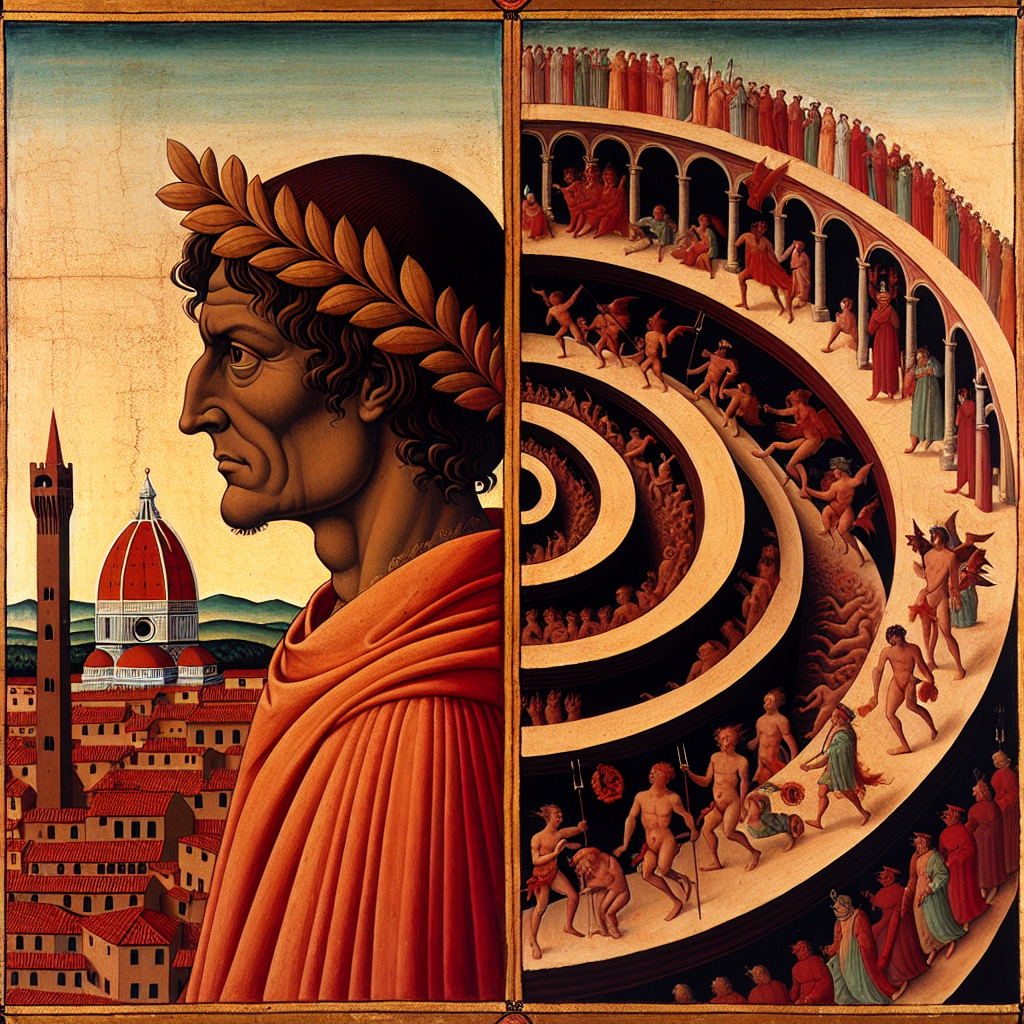
It's been a while since I've added an entry to project #EuropeanBios, and part of that is because I've been unlucky in my available bios. But here at last is entry #32, Dante Alighieri, a philosopher and the poet famous for writing the Divine Comedy, born 1265.
-
I always look for personal connections between the subjects of this project, and Dante has a lot. As a philosopher and poet he was influenced by several of our other subjects, including Augustine of Hippo, St. Francis, Thomas Aquinas and even Albert the Great.
-
Dante was a poet down to his core, and fulfills every stereotype of a poet you can possibly imagine. At least from his writing he sounds impossibly dramatic and overwrought, a completely insufferable drama queen. As will become clear, I know nothing about poetry.
-
Dante grew up in Florence, to a noble family from whom he inherited wealth. Like lots of people who've always had money, he affected to not care about money, calling people who lusted after wealth corrupted, at least until he lost all his money and was forced into exile.
-
Florence at the time of Dante was a boiling cauldron of political upheaval, originally between two factions known as the Guelphs and the Ghibellines, and then once the Ghibellines lost between factions within the Guelphs known as the Black Guelphs and the White Guelphs.
-
The details of the conflict and political positioning are supremely dull but the result is that Dante, a White Guelph, was permanently exiled from Florence around 1301, aged 36. He was tremendously affected by this event and most of his important works date from after it.
-
The other huge influence on his writing was a woman called Beatrice. She was not his wife and according to Dante he only met her twice, once when she was nine years old, and then once on the street, but he affected a deep and undying love for her and wrote endlessly about her.
-
At this point, Dante's biographer departed into 20 hours of blathering on about the various conceptions of love, and death, and god in his writing. It was all totally impenetrable to me. I understood each word in each sentence but the sentences themselves were meaningless.
-
It was kind of a zen experience, listening to 20 hours of meaningless words. Random phrases that the author used frequently like "properly human being" and "in the economy of the whole" and "and this therefore is the point" drifted like ice cubes in the lemonade of un-meaning.
-
So I'm definitely not qualified to say anything about Dante's poetry. It may have been a masterwork, a multi-layered tapestry full of infinitely subtle meanings, or the guy who wrote this biography may have just spent 20 hours randomly mashing his keyboard. I have no way to tell.
-
What is known is that Dante was tremendously influential to other poets for hundreds of years thereafter, so whether he really was as clever as his biographer believed he was certainly popular.
-
Dante also wrote in "the vernacular", which is to say the Italian language, at a time when most writing in Italy was in Latin. He wrote a long defence of the vernacular as a respectable language for writing, and in fact his using it helped standardize Italian into modern form.
-
My primary conclusion from reading 24 hours of biography about Dante is that academics are terrible writers who can turn even what is generally recognized as some of the best poetry ever written into tedious waffling, and that I should probably avoid bios of poets going forward.
- Previously: Marco Polo
- Next: Isabella of France
- Full list
Text and images copyright © 2020-2023 Laurie Voss
except where indicated
except where indicated