Genghis Khan
-
Entry #28 in Project #EuropeanBios is Genghis Khan and my friends, you are in for a treat. I knew almost nothing about him and he turns out to have been a fascinating man of staggering ambition, power and ability, a world conqueror outdoing even my fave Alexander the Great.
-
Part of what makes him a fun subject relative to other notables from the years 400-1200 is that we know an enormous amount about him, because the Mongols under him became literate and wrote everything down in a meticulous, secret, internal-only history.
-
But first, let's get this out of the way: he was not a nice guy. He was a military leader who conquered the whole world; nobody who does that is a nice person, and he was no exception. He personally killed probably hundreds of people and his armies left millions dead.
-
As usual, this thread is not a biography, this is just the fun facts. If you want to know everything he got up to I thoroughly recommend the bio I read, which is only about 50% about Genghis Khan and 50% about his equally-impressive grandson Kublai Khan
-
Let's start with the most basic thing about him: his name was Temüjin; "Genghis Khan" was his title. "Khan" just means ruler, every ruler of the Mongols was a Khan. "Genghis" is translated as either "Unshakeable" or "Universal"; he unified the Mongols and ruled all of them.
-
The name "Temüjin" is a Mongolian concept that does not translate easily, but has been described as "the look in the eye of a horse going where it wants to go". Horses were an extremely big deal to the Mongols, who bred them, drank their milk and their blood, and ate their meat.
-
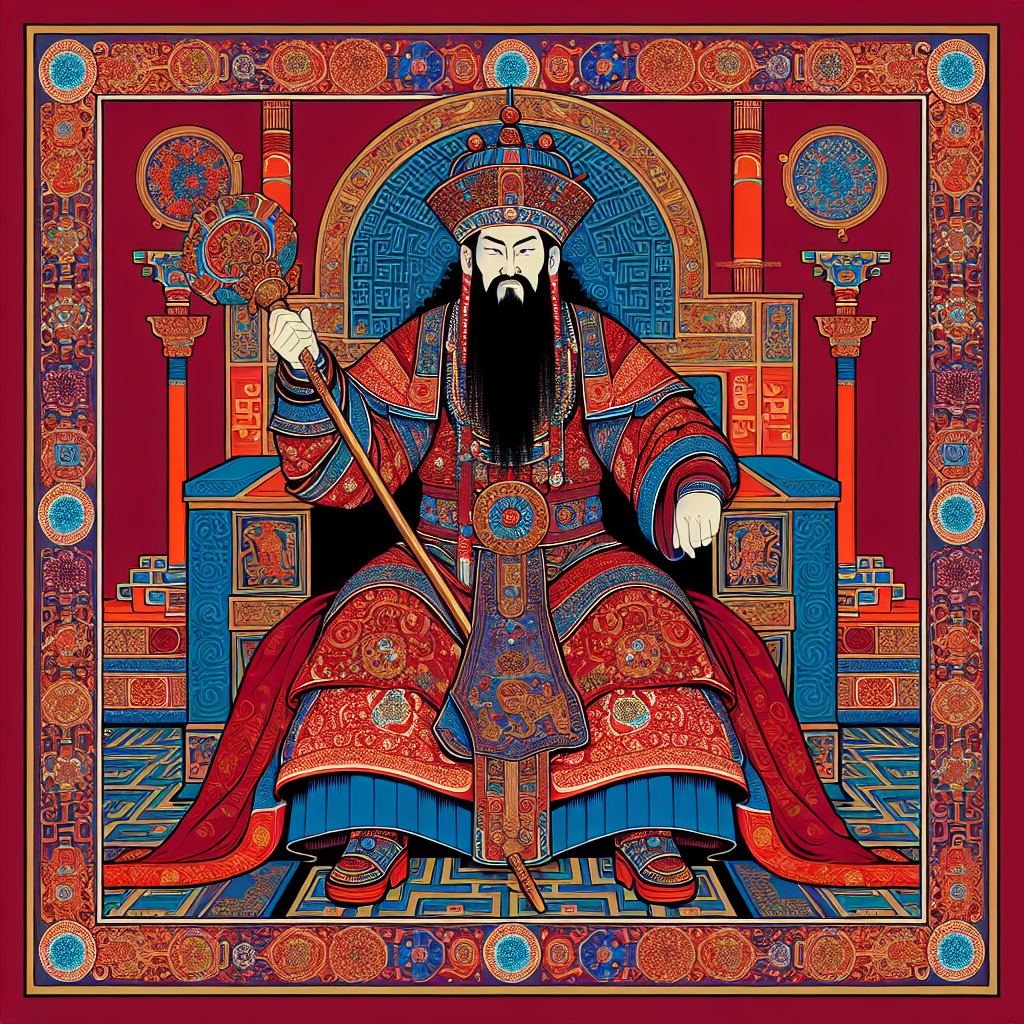
We have no idea what Temüjin looked like, so I haven't included any pictures of him. Many depictions of him make him appear Chinese, but these were commissioned by his grandson Kublai, who had absorbed Chinese culture, so it was politically useful to make him appear Chinese.
-
At the time of Temüjin's birth around 1160 the Mongols were a border people: they occupied marginal land that provided only so-so herding and hunting opportunities, and they were far from trade routes. To supplement their existence they would regularly raid other communities.
-
This habit of pillaging towns means they are described as a warrior people but it was very low-grade, more like banditry than warfare. Their raiding was seasonal and they did not conquer new territory. They existed as separate tribes with kinship bonds and no central ruler.
-
Temüjin's father was pretty big deal but he was poisoned when Temüjin was 9 years old by his enemies, for kidnapping Temüjin's mother. His mother, now a widow, was abandoned by the tribe and Temüjin and his family lived a poverty-stricken existence, scavenging for food for years.
-
During this period Temüjin killed his half-brother in a fight over who should run the family. Mongol culture is very against bloodshed (literally the shedding of blood; killing by other means is better) so he became an outlaw; anyone could kill him without consequences.
-
While on the run for this murder he was captured and enslaved for an unclear length of time. The Secret History, detailed and usually accurate, brushes over this period as an embarrassment to the otherwise stellar legend of Temüjin. It may have been as long as ten years.
-
He eventually escaped, and it appears for a while he tried to live a more peaceful existence, taking a wife and settling into tribal traditions. But as part of usual inter-tribal struggles his wife was kidnapped and Temüjin had to lead a party to get her back.
-
All of these experiences seem formative: a life of desperate poverty, cruelty inflicted on his family by strict traditions, violent struggles for power and survival. Unable to live safely in peace, he seems to have decided to achieve personal safety by conquering the world.
-
I am going to brutally abbreviate his rise to power, otherwise we'll be here all day, but one surprise to me is that he spent half of his long life uniting the Mongols in the first place. Unlike Alexander, who was dead by 32, Temüjin was well into his 40s before he left Mongolia.
-
His rise to power within the Mongols came partly because, as an outcast and victim of tribal cruelty, he rejected Mongolian traditions of warfare and ignored hereditary status. He promoted his generals based on skill and loyalty, and split soldiers into uniformly-sized units.
-
He changed the pattern of Mongolian warfare: instead of winning a battle, looting any valuables, and leaving the survivors to fend for themselves, he instead practiced total victory: he destroyed towns, killed their leaders and absorbed the survivors into his tribe as equals.
-
He also changed how spoils were distributed: instead of every man for himself, all the loot was collected together and then divided into shares according to a strict code. The son of widow, Temüjin made sure this included a share for widows and orphans, given after every victory.
-
The result was that with every victory, the Temüjin's tribe grew stronger, richer, and larger. Around 1200 the Temüjin's tribe conquered and absorbed the Tatars. There were so many Tatars at every level in the Mongol army that Europeans tended to refer to the Mongols as Tatars.
-
There was no real distinction between "Temüjin's tribe" and "Temüjin's army". Everyone was in the army, and everyone in the army was part of the tribe. As Temüjin absorbed tribe after tribe, by 1206 there was also no difference between "Temüjin's army" and "the Mongols".
-
Temüjin was by this point somewhere between 45 and 50 years old and had conquered a gigantic swathe of territory. He could have stopped there, but he was just getting started. He began to expand in a series of campaigns over 20 years, captured in this trio of maps.
-
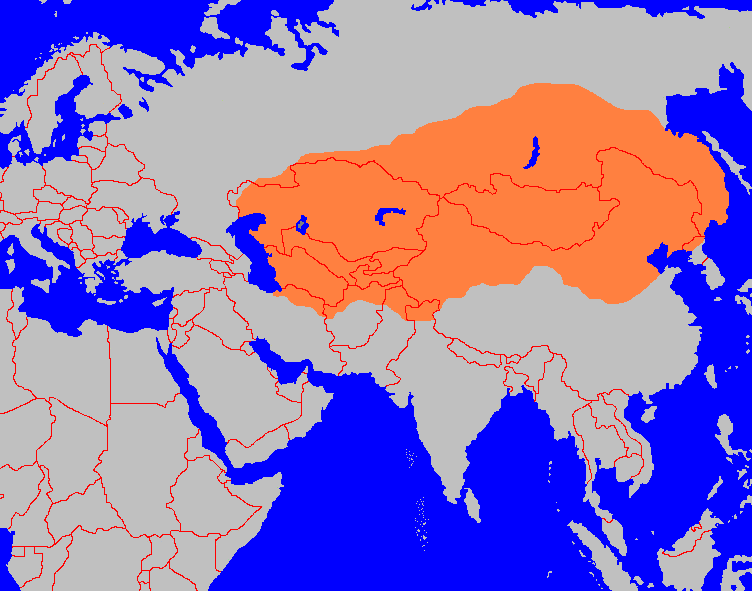
Map showing the extent of Mongol conquests from 1206 to 1227 under Genghis Khan Mongol Empire 1206–1227 by Postmann Michael via Wikimedia Commons, public domain -
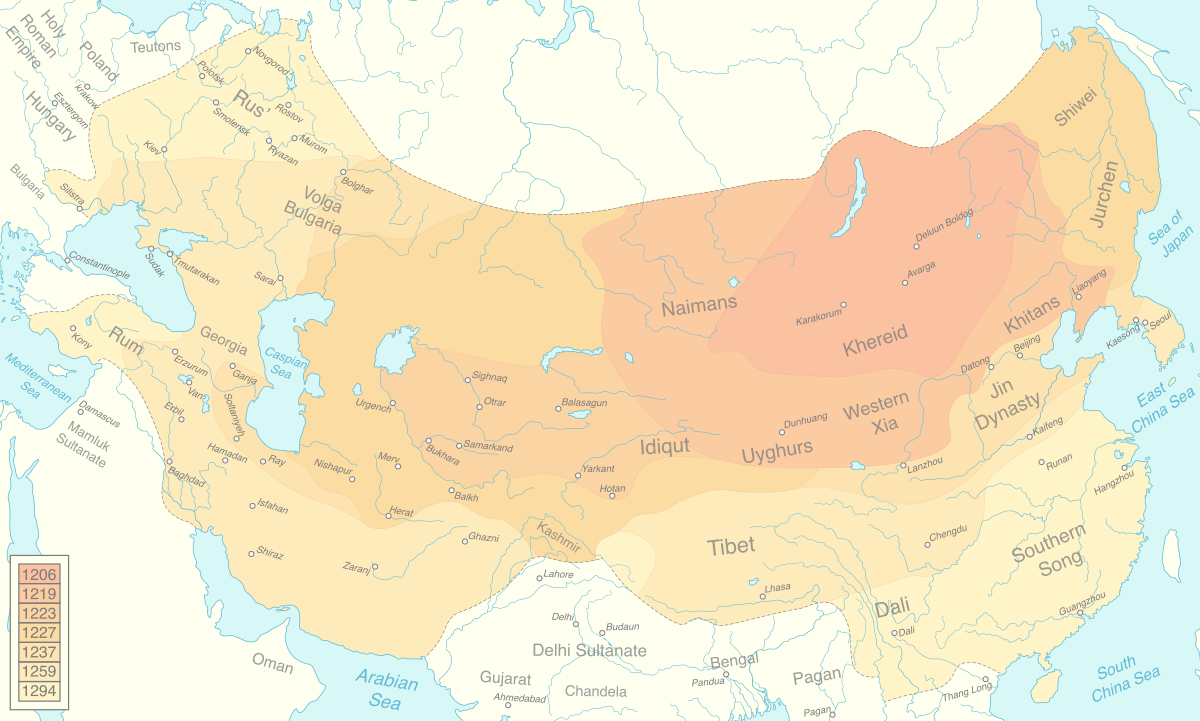
Map showing all stages of Mongol Empire expansion from 1206 to 1294 Expansion of the Mongol Empire 1206–1294 by Cattette via Wikimedia Commons (CC BY-SA 4.0) -
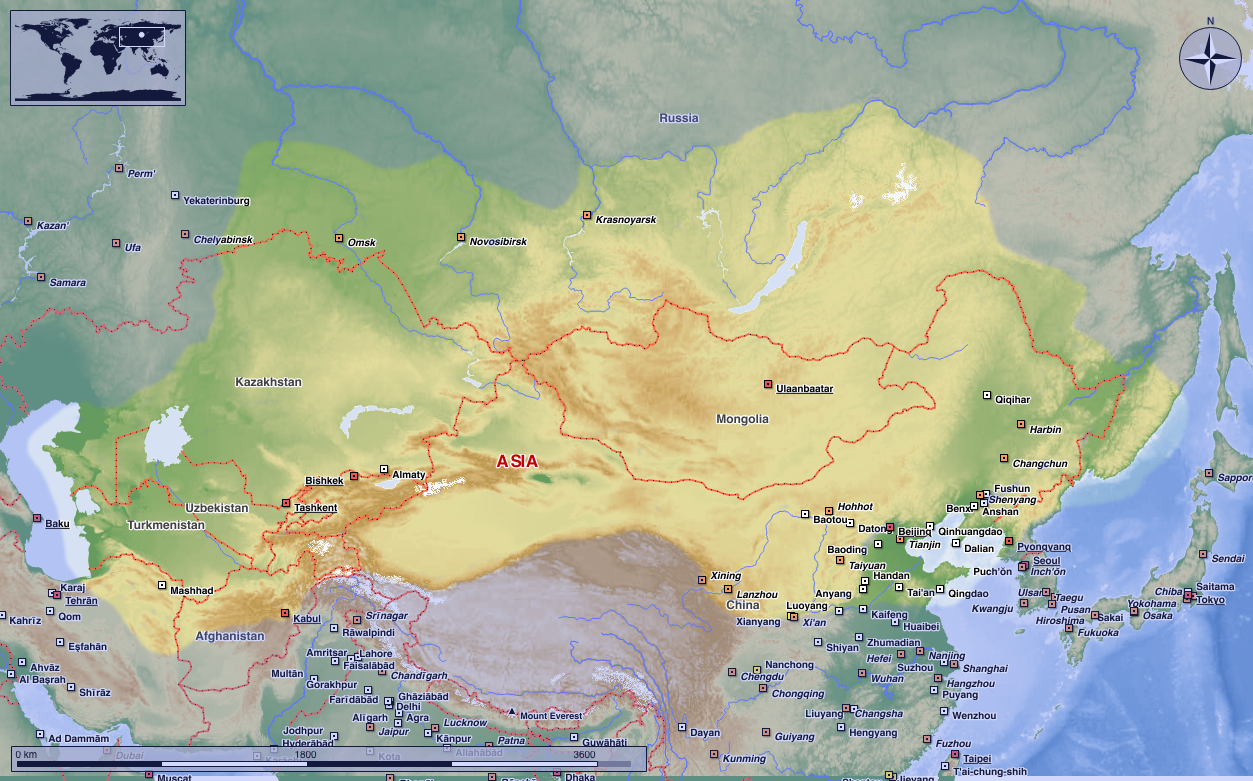
Map showing the Mongol Empire at the death of Genghis Khan in 1227 Empire of Genghis Khan in 1227 by MicBy67 via Wikimedia Commons (CC BY-SA 4.0) -
Part of why he was so unstoppable was that he was no one-trick pony. Most world-conquerors have a single tactic or technology that allows them to run rampant until the world comes up with a new defence, but Temüjin absorbed tactics and technology from everyone he conquered.
-
The Mongol army had excellent bows and were terrific horsemen. They had siege weapons like catapults for attacking fortified cities. They had gunpowder, in the form of primitive hand grenades and incendiaries. And they had fantastic engineers, who built walls and dug tunnels.
-
His army of tens of thousands needed to distribute orders, but couldn't read or write. So they invented a set of rhyming songs, into which they could insert orders. If you got the order wrong, the song wouldn't sound right, so it acted as automatic error-correction.
-
By this point Temüjin was already well into legendary territory, but merely conquering the world wasn't enough. Unlike other world-conquerors, he turned out to as adept at running the world as conquering it. He invented a state and a system of laws from whole cloth.
-
His legal system forbid kidnapping (his mother had been kidnapped and so had his wife) and slavery (he had been a slave). He declared all children legitimate (there were questions as the legitimacy of his first son). And he declared complete religious freedom.
-
He built an incredibly efficient postal system to carry his orders, essential for ruling a territory as large as his own, though literacy was not widespread and Temüjin himself probably couldn't read or write.
-
Temüjin died in 1227 while on campaign, but it's not clear how. It may have been in battle, or of illness. He may have been as old as 72 at this point, so illness seems more likely, especially since if he'd died in battle the Mongols probably would have boasted about it more.
-
At this point it's worth asking why, given the extent of his territory when he died, I've included Temüjin in a series of biographies of Europeans at all, and the answer is: his kids kept going. They took Russia and Eastern Europe as far as Hungary (Attila's former territory).
-
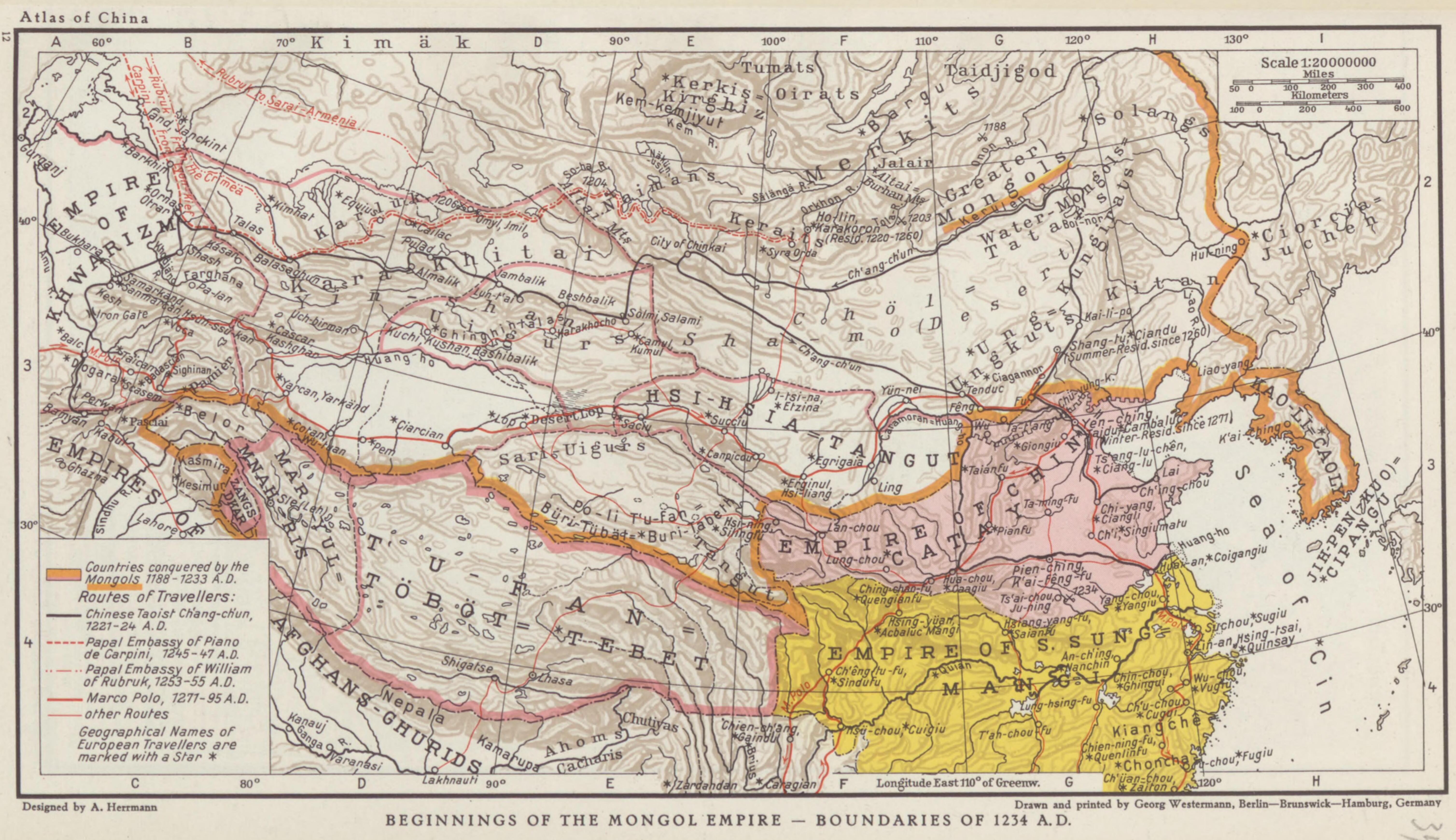
Map showing the Mongol Empire's boundaries at 1234 AD after continued expansion under Ögedei Khan Beginnings of the Mongol Empire, Boundaries of 1234 AD, by A. Herrmann & G. Westermann, public domain -
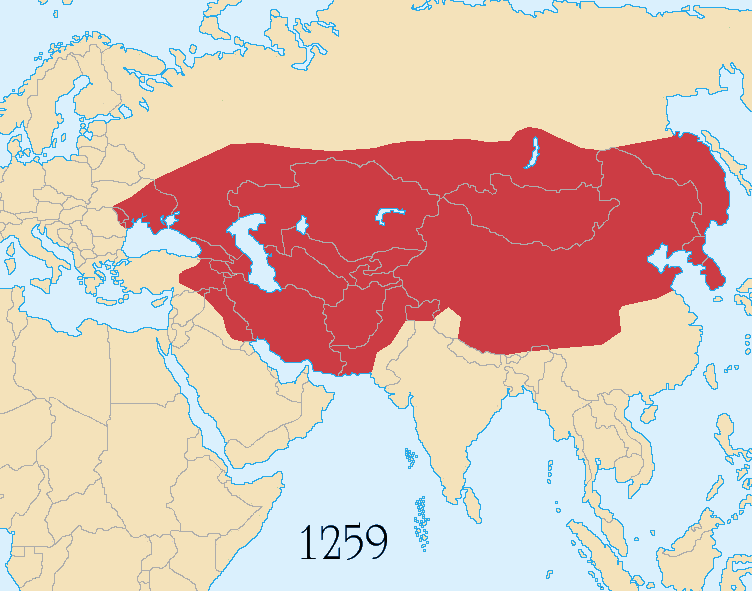
Map showing the Mongol Empire at its greatest extent in 1259 Mongol Empire in 1259 by Astrokey44 via Wikimedia Commons (CC BY-SA 2.5) -
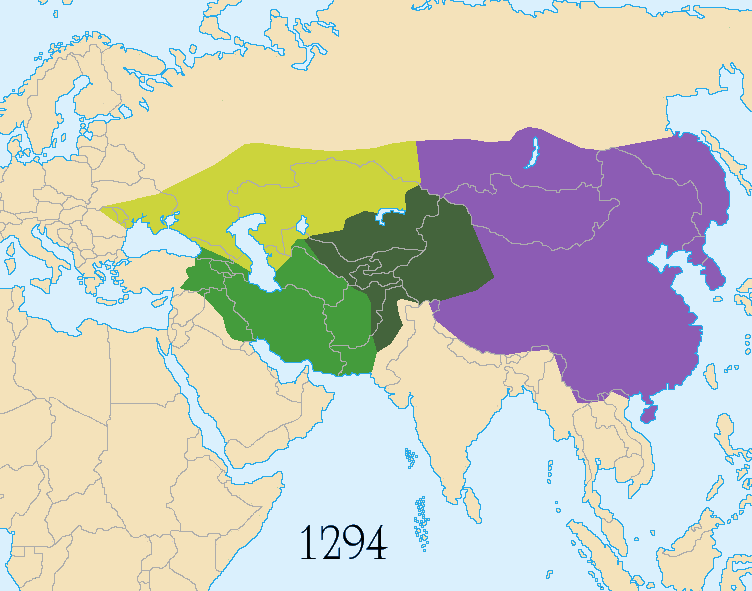
Map showing the Mongol Empire in 1294 beginning to fracture into separate khanates Mongol Empire in 1294 by Astrokey44 via Wikimedia Commons (CC BY-SA 2.5) -
The Mongolian empire also profoundly influenced Europe, and indeed most of the world. Their tremendous trading network distributed goods and technology from east to west, massively raising the standard of living in Europe, which had been a backwater for centuries.
-
Temüjin did fit the world-conqueror stereotype in another way, which was: he fucked up the succession. On his death, his eldest son (who may not have been biologically his) was not accepted as hier, and after a lot of internal fighting it went to a younger son, Ögedei.
-
As a side note: you may have heard that Temüjin had a lot of kids, and this is true. Genetic studies show that something like 1 in every 200 men alive on earth have Y-chromosomes directly from him. He had at least 13 official wives and uncounted numbers of concubines.
-
It's also worth mentioning that there were a number of extremely impressive women in Temüjin's life, in particular his first and probably primary wife Börte, who appears to have done a lot of empire-ruling while Temüjin was away conquering new territory.
-
By the time of Temüjin's grandchildren the empire had fractured into five major "Khanates" that semi-pretended to still be a single empire. But unlike the empires of Alexander and Attila, the Mongol empire itself lasted and continued to expand long after his death.
-
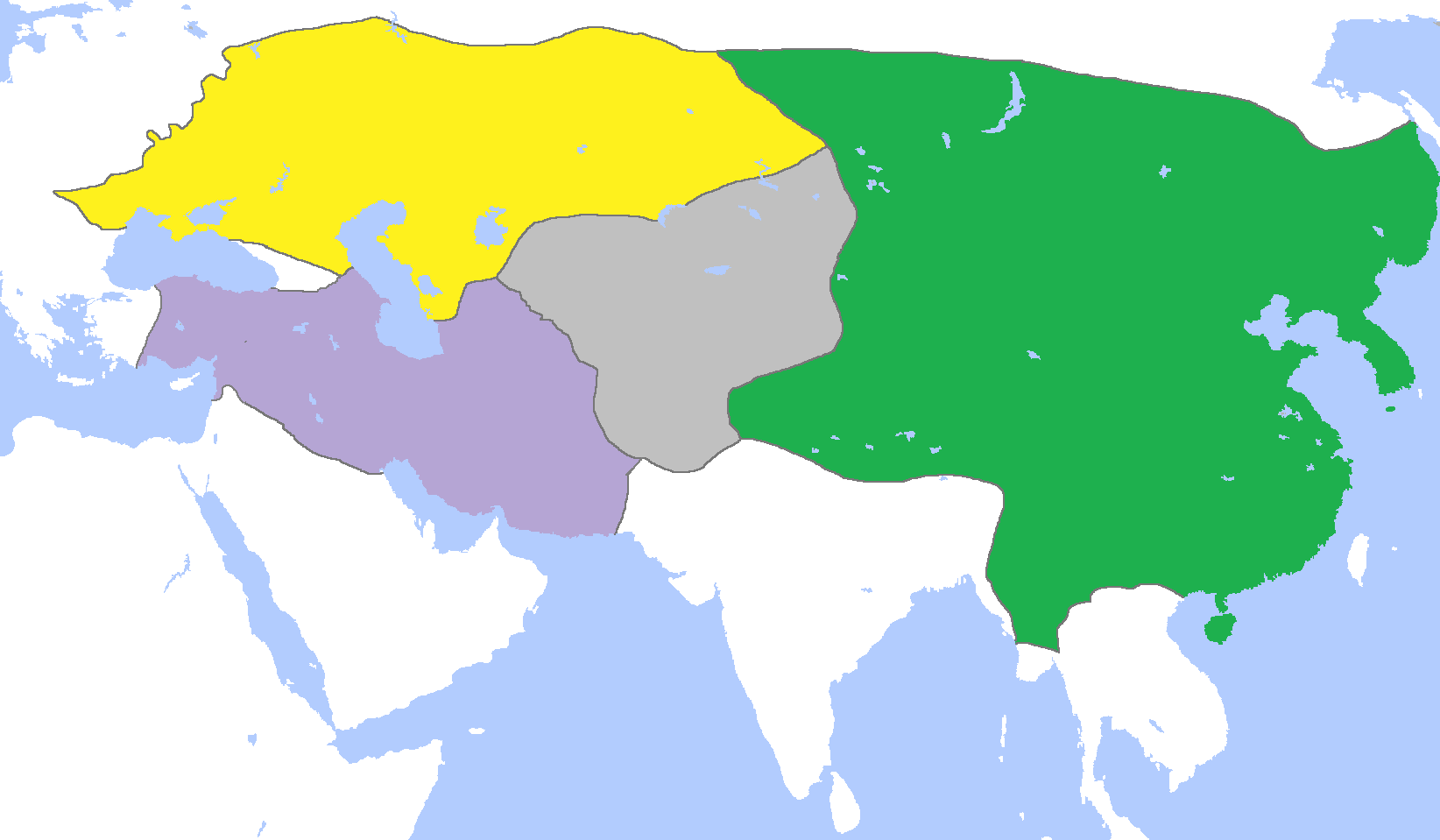
Map showing the Mongol Empire divided into its successor khanates around 1300 Mongol Empire Divisions by Gabagool via Wikimedia Commons (CC BY 3.0) -
Under Temüjin's grandson Kublai Khan, the empire transformed into an almost unrecognizably different culture: rich, literate, sedentary, with a permanent capital (something Temüjin would have considered a mistake), heavily influenced by the Chinese culture it had absorbed.
-
Temüjin is best compared to Attila the Hun (TKTKTK) and Alexander the Great (TKTKTK), both massively successful conquerors of vast swathes of Asia and Europe. But Temüjin was by far the most successful of the three.
-
It's hard to overstate how impressive he was. He rose from a starving orphan to undisputed ruler of the world, conquering parts of the world so far apart they had never heard of each other. And he built a government that ran efficiently for more than a century after his death.
-
Temüjin is a good candidate for the single most powerful human to have ever lived (my other candidate, for quite different reasons, is FDR). His military, legal and cultural innovations reshaped how the world was run, and he also fathered 0.5% of all living men.
-
In terms of legacy, it's really hard to beat Genghis fucking Khan.
-
Post-script 2: Temüjin's grandson Kublai Khan was very impressive but I decided not to cover him immediately; a few bios from now we'll be covering Marco Polo, who spent a lot of time with Kublai.
- Previously: Richard Lionheart
- Next: Francis of Assisi
- Full list
Text and images copyright © 2020-2023 Laurie Voss
except where indicated
except where indicated