Ivan the Terrible
-
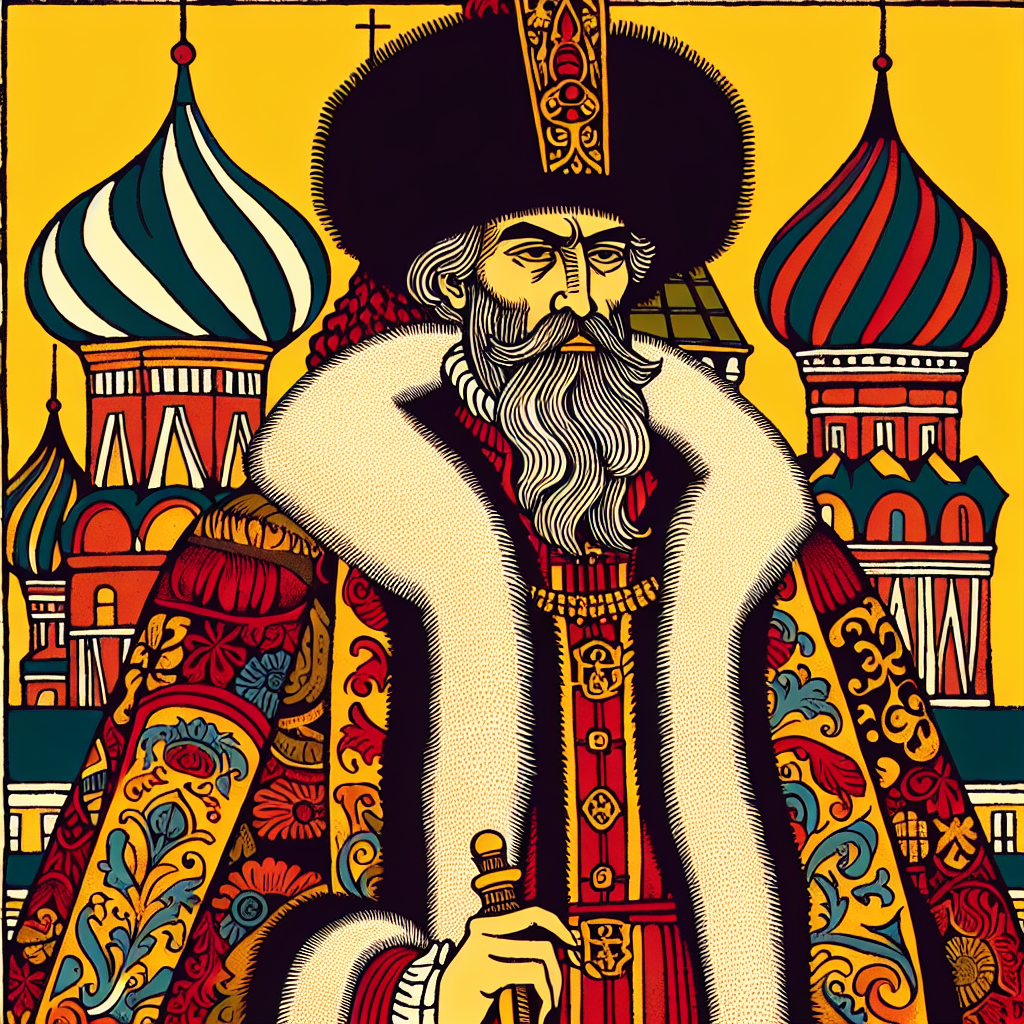
It's Sunday night and I finished a bio so here we go, #EuropeanBios #46, Ivan The Terrible. Nearly all European nobility were pretty awful people but *this* guy has terrible right in the name, and it's not undeserved! This is going to be a short thread of a truly brutal life.
-
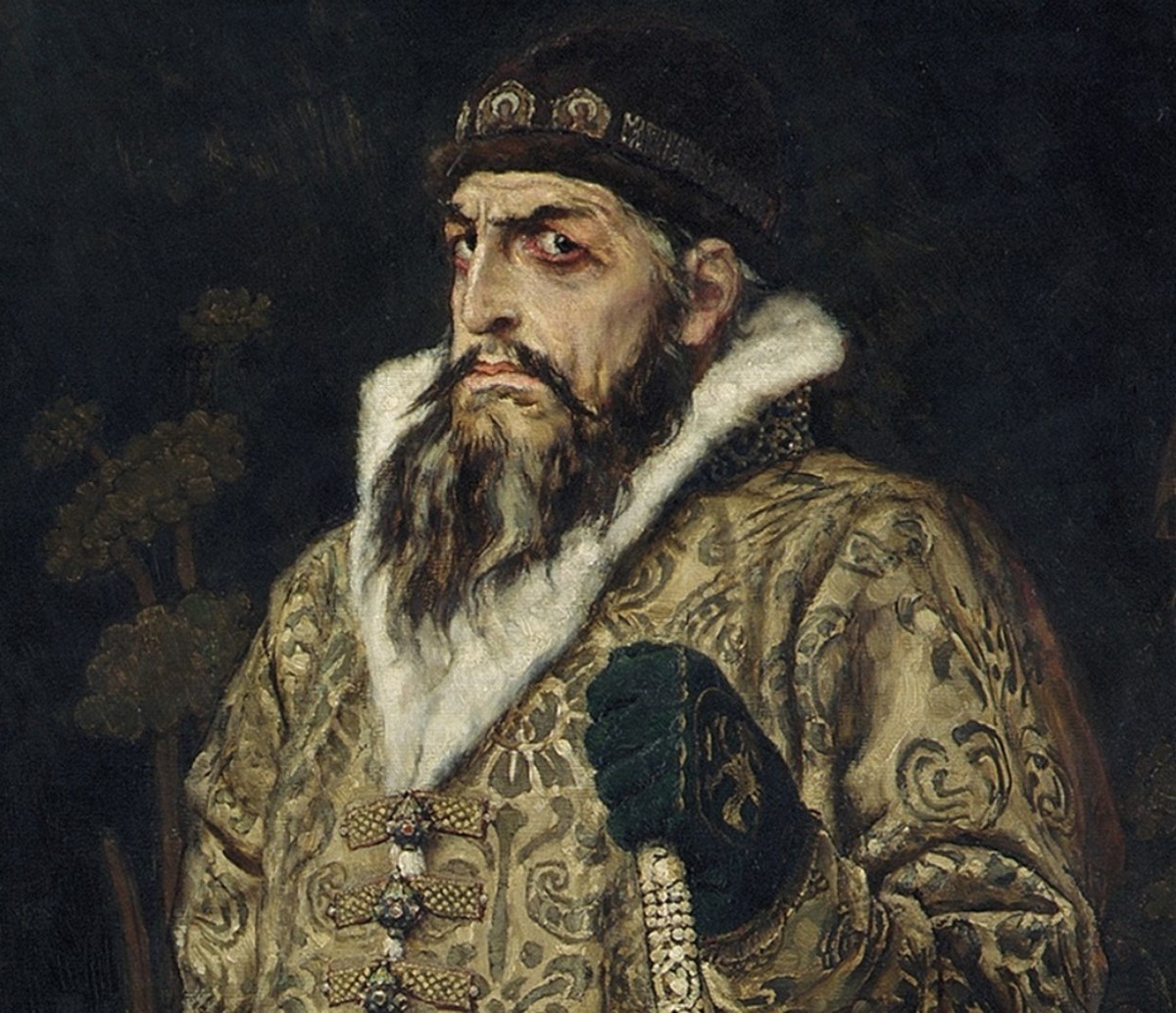
Portrait of Ivan the Terrible, Viktor Vasnetsov, 1897 public domain -
But first, a fun fact about his name: Ivan was known as "Ivan Grozny" in Russian, a word which translates to something more like "Ivan the Formidable" or "Ivan the Fearsome". At the time, the word "terrible" in English meant something pretty similar: awe-inspiring, intimidating.
-
But Ivan was terrible, in the modern sense. He was so awful that the word "terrible", associated with him and all the things he did, changed meaning in the 1590s after he died to *mean* bad, awful. He wasn't called terrible; *terrible is named after him*. He was that bad.
-
Ivan was born in 1530, the son of the ruler of the Grand Duchy of Moscow, and thus to inherit his rule. His father died when he was three, however, leaving him nominal ruler with his mother acting on his behalf. Compounding his misfortune, she also died when he was eight.
-
His mother was almost certainly poisoned by agents of the boyars, a set of noble Russian families who wielded great influence in Russian politics at the time. Most of Ivan's life was the result of or reaction to the boyars' political meddling.
-
With his mother dead, the boyars controlled Ivan as a puppet child king. He was by most accounts abused, neglected, possibly molested, and generally had a shitty childhood. He began to show signs of violent mental instability at an early age, torturing animals for fun.
-
At age 13 he began to seize control back from the boyars. He summoned them to a meeting, berated them for their corruption, and then had their leader, Prince Andrey Shuysky, thrown to a pack of hungry hunting dogs. They responded by giving him full control of the empire.
-
(It's worth asking *why* they did that, because they would do it several more times. The answer is that the Russian public liked their ruler, or at least liked him better than the boyars. They couldn't seize power directly because the public would have killed them for it.)
-
At age 17 Ivan was married after a sort of beauty pageant competition in which he picked his wife out of thousands of girls. This marriage turned out to be a surprisingly good match; Anastasia Romanovna was a calm and gentle woman who restrained his worse impulses for many years.
-
Unfortunately after 13 years Anastasia died, aged 30 of what was probably natural causes. Grief provoked a mental breakdown in Ivan, who blamed the boyars for poisoning her like they had poisoned his mother. He began killing boyars indiscriminately.
-
He began to get progressively more erratic, alternately threatening to abdicate (which nobody wanted, not even the boyars, because it would throw Russia into chaos) and then demanding absolute power. The boyars, having no support from the public, were forced to give it to him.
-
His mental instability and paranoia continued to increase, centered around the boyars. Ivan split the Russian empire, creating an area called the Oprichnina where boyars were supposed to be completely excluded.
-
He created a private army, the Oprichniki, who were supposed to enforce this policy in the Oprichnina, but instead they conducted a reign of terror, killing boyars and non-boyars alike, often cruelly torturing their victims.
-
The nightmare of the Oprichniki peaked with the massacre of Novgorod. Fearing a rebellion by the boyars, Ivan ordered the town sacked. Thousands of innocent people were cruelly killed and the surrounding farmlands ruined; the city never recovered its former status.
-
He married again, a politically advantageous marriage to Maria Temryukovna, from the Muslim Caucasus region. She was nothing like the calming influence Anastasia had been and was also unpopular with the snobbish court. Ivan regretted the marriage, so he poisoned her to death.
-
At this point Ivan's wild cruelty becomes so erratic that it becomes quite hard to separate fact from fiction. He married a third woman, Marfa Sobakina, who died within weeks, apparently being accidentally poisoned by her own mother, who gave her a fertility potion.
-
He very quickly married a fourth woman, Anna Koltovskaya, but grew tired of her after just three years and had her sent to a convent after she failed to bear him a child. He followed this up by immediately marrying Anna Vasilchikova, and also sent her to a convent that same year.
-
His 6th and 7th wives may not have existed. It says quite a lot about how out of control things were with Ivan that he ruled a whole country and an apparatus of government and yet it's not clear whether two of his wives, Vasilisa Melentyeva and Maria Dolgorukaya, are real.
-
Wife number 8 (or possibly 6 if you don't count the two fake ones, who may have been invented in the 19th century to spice up his story) was Maria Nagaya, who gave birth to his eighth child, Dmitri Ivanovich, though most of his children died at a young age.
-
His second son, Ivan Ivanovich, met a famously gruesome fate. Ivan disapproved of his son's choices in wives, and had already had two of them sent to convents. This understandably had caused some friction between father and son, who nevertheless married a third time.
-
Ivan, obviously mentally unstable, decided one night at dinner that this daughter-in-law, Yelena Sheremeteva, who was pregnant at the time, was wearing clothes that were insufficiently modest. He responded by savagely beating her, causing her to miscarry.
-
Ivan's son was understandably enraged by this, and father and son then engaged in a heated argument which resulted in Ivan smashing his son's head in with his scepter of power, killing him, memorialized in a famous painting by Ilya Repin.
-
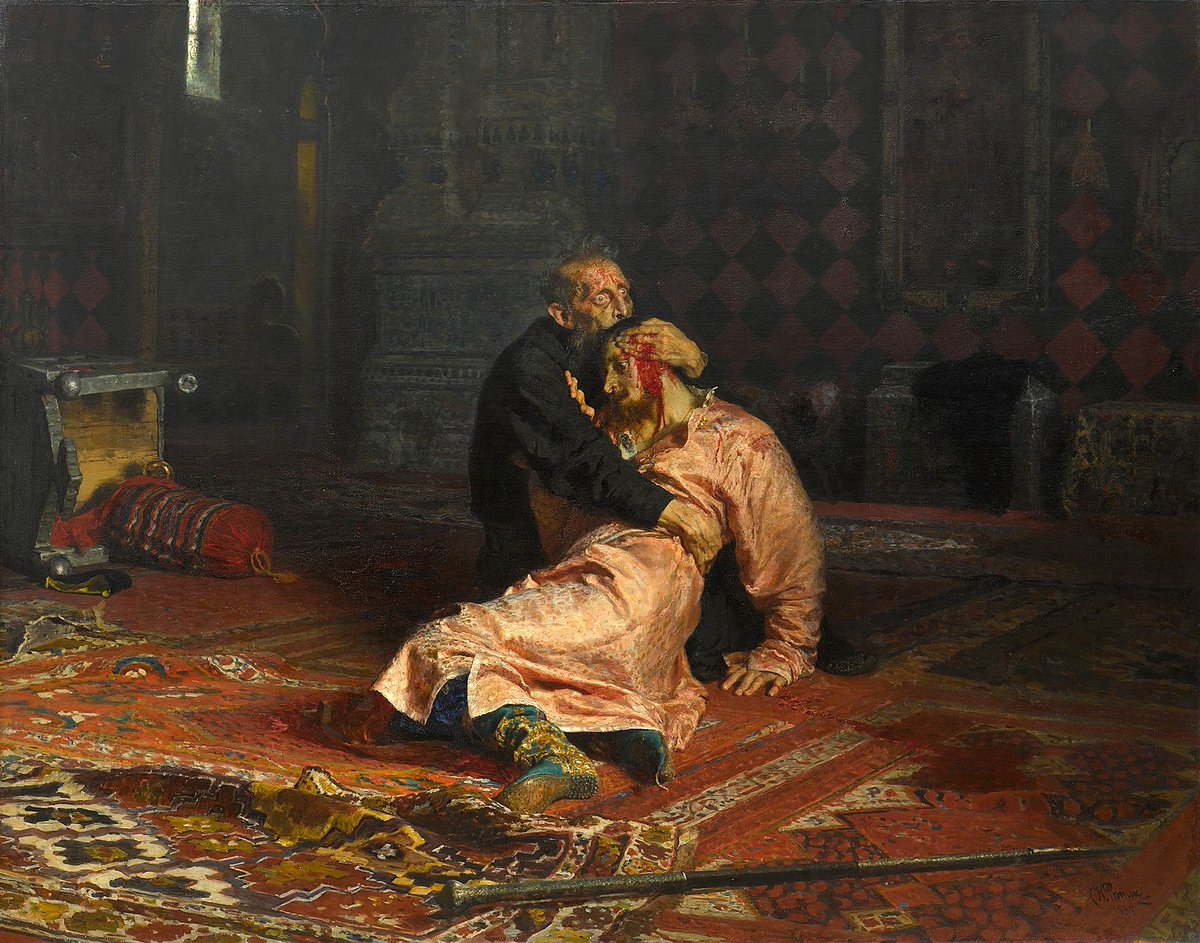
Ivan the Terrible and His Son Ivan, Ilya Repin, 1885, Tretyakov Gallery Moscow public domain -
Ivan himself died four years later, in 1584, of a stroke. His son Feodor inherited his rule but was mentally incapable of ruling and the Russian empire fell into the chaos the boyars had feared all along.
-
Phew. Ivan the Terrible was a lot. Physically, mentally and emotionally abused as a child and then handed absolute power, his life was a nightmare for everyone including him. Truly I have covered some bastards in this series but Ivan, wow, he deserves the name.
- Previously: Catherine de Medici
- Next: Elizabeth 1
- Full list
Text and images copyright © 2020-2023 Laurie Voss
except where indicated
except where indicated