Ivar the Boneless
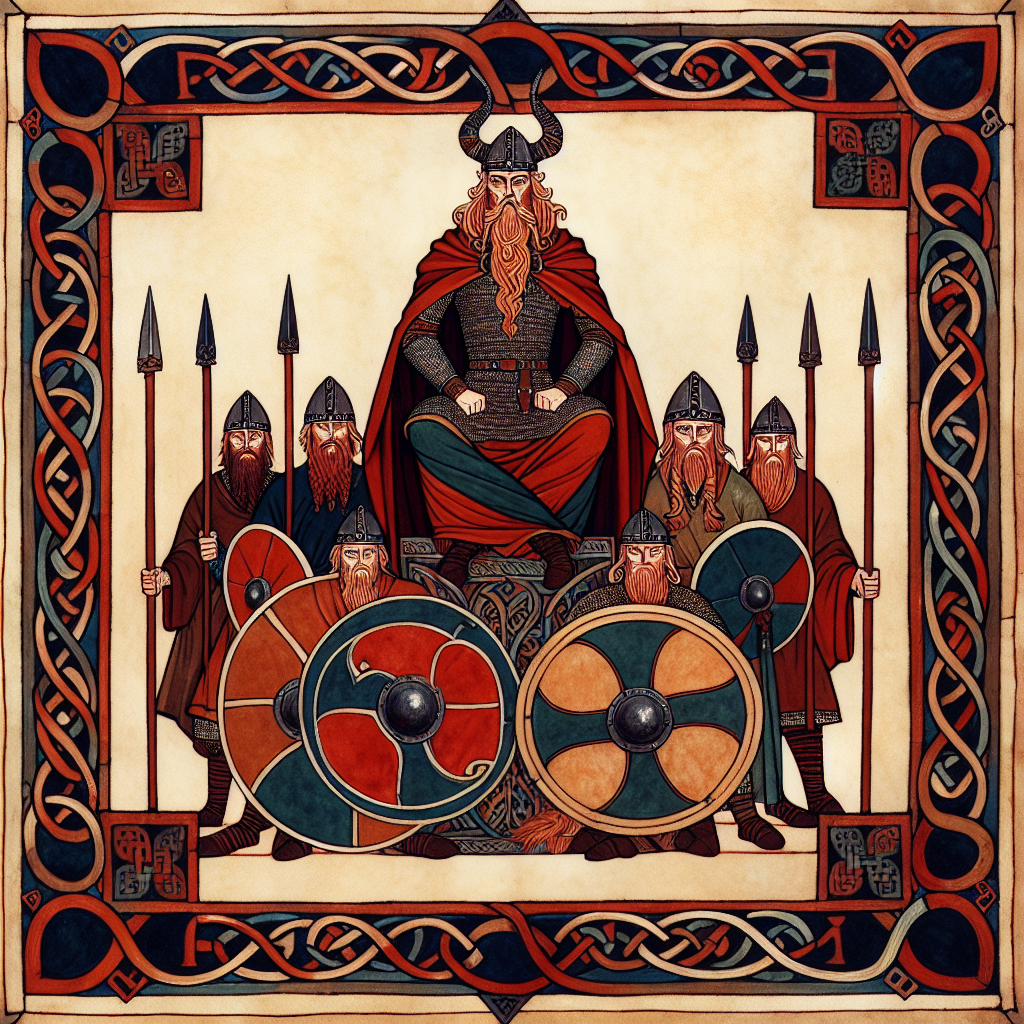
-
Our focus in #EuropeanBios has been moving north from the Mediterranean through France and Germany, and now to Norway. The years 793-1066 are known as the Viking Age, and our first stop is going to be #20, Ivar The Boneless, who honestly I'm covering mostly because of his name.
-
Ivar was born around 825 (plus or minus like 20 years, details are hazy), so not too long after the death of our last subject, Charlemagne. He was the son of Ragnar Lodbrok, a Viking king of the Denmark/Norway/Sweden area.
-
Fun fact: Vikings didn't call themselves Vikings. "Viking" was a verb, not a noun. It described the way they rowed their longboats in shifts. So they were called "Vikings" like you'd call other people "Sailors". The word "Viking" existed as a surname, like "Smith" or "Tailor".
-
Ivar's dad Ragnar seems like a pretty interesting dude, but it seems people liked him so much they started attributing things to him he'd never done, much as we attribute any witty saying to Mark Twain, until today nobody has any idea what Ragnar really did or was like.
-
So much amazing stuff is attributed to Ragnar that historians consider him semi-mythical, the Viking version of King Arthur. But we know about his kids and what they did, and while details are pretty hazy about them, they definitely weren't myths. They invaded England in 865.
-
The reason Ivar and his brothers invaded England was to avenge Ragnar's death at the hands of king Aella of Northumbria, who executed him by throwing him into a pit of snakes. Of course, this begs the question as to what Ragnar was doing in Northumbria in the first place.
-
The Vikings have a reputation for being basically pirates, who travelled the seas, raiding and pillaging coastal towns, and this is true as far as it goes: they definitely did a lot of raiding and pillaging. But it turns out this was sort of a part-time hobby for them.
-
Most of the time the Vikings were farmers, fishers and traders, living across Northern Europe. They didn't have a single ruler but instead a bunch of unrelated tribes who peacefully coexisted. They had a complex system of laws, they played games, they even played chess.
-
The Vikings had a concept of local government called a þing, pronounced "Thing", which makes Viking histories accidentally hilarious to modern ears, because Vikings are constantly "holding a thing", "attending a thing", "demanding a thing" etc. like they're from LA.
-
But Vikings also had a technology nobody else did: their longboats. These were faster, stronger, more versatile, and more reliable ships than anybody else had in the world at that time. Vikings were also great navigators, though it's not clear today how they managed this.
-
The current best theory is that they navigated using the sun, even on cloudy days, by using calcite crystals. Calcite crystals split polarized light from the sun in a predictable way that can be used to precisely locate the sun and thus where you are. Studies have shown this would be very accurate, and Norse sagas do mention "sunstones".
-
However they managed it, the result was a race of globe-trotters. There is evidence that as traders they regularly got as far as Baghdad in modern-day Iraq. They also colonized Iceland, Greenland (temporarily) and (even more temporarily) North America, of which more in later bios.
-
All of which is to say: the reason Ragnar was in Northumbria is indeed because he was attempting to pillage it, so fair play to Aella for defending himself, though the snake pit seems a little overkill. When Ivar and his brothers heard about it they were pissed.
-
Vikings were big users of nicknames to distinguish each other. Usually the name was descriptive, sometimes it was sarcastic. Frustratingly, despite his extremely memorable name, the reason Ivar the Boneless got his nickname is unrecorded. There are lots of theories!
-
Theory 1: he had no bones. At least one source said he had "only gristle" where his bones should be. Arguments against this are that you can't have *no* bones, you'd die, but 12th century Norse sagas weren't big on fact checking. Likelihood: 0/10.
-
Theory 2: he had no legs. Viking words for "leg" and "bone" were the same, so it's possible he had no legs. Arguments against this: he was a famous warrior king, and 8th century battlefields were not notably accessible. Some sources claim he was carried around! Likelihood: 1/10.
-
Theory 3: he had bones but they were really brittle due to a genetic condition. In this one he'd be able to walk around but maybe having weak bones would get the exaggerated reputation as having no bones. Again: still a warrior, unlikely to have been fragile. Likelihood: 2/10.
-
Theory 4: he had no sperm. In this one "boneless" was a metaphor for impotence. Ivar had no children, so this is at least potentially possible. Arguments against: he was powerful, well-liked and notably violent man, so an insulting nickname would be short-lived. Likelihood: 3/10.
-
Theory 5: he was really athletic and bendy. One source claims that he was particularly loved by the women for his antics in bed. In this case the "boneless" meant high flexibility, something more plausible in a famous warrior. Plausibility: 5/10.
-
Theory 6: he was really bendy due to a genetic condition like Marfan syndrome. Depending on severity, Marfan can make you both tall (see later) and notably flexible. His condition is described as being evident from birth, so we're getting to plausible now. Likelihood: 6/10.
-
Theory 7: he was very persuasive. Here "boneless" is a metaphor for snake-like persuasive skills. The Vikings were big on snakes; Ivar's brother was called Sigurd Snake-in-the-Eye. Now you're getting to something you might call your much-loved warrior king. Likelihood: 7/10.
-
Theory 8: he had huge bones and "boneless" is ironic. Excavations at St Wystan's southern Derbyshire, where some sources say Ivar died, have uncovered a huge burial site of an important Viking who was 9 feet tall. A famous warrior king being exceptionally tall? Likelihood: 8/10.
-
So maybe he was tall, maybe he was persuasive, maybe he was bendy, maybe he was impotent, maybe he was some combination. Regardless, in 865 he managed to persuade all the Viking tribes to band together into a huge fleet known as the Great Heathen Army, and attack England.
-
This is where Ivar bumps into our next subject, Alfred the Great. Since I don't have a lot on Alfred otherwise, this is where I'm going to end Ivar and we'll pick up the Viking Age story in my next thread.
- Previously: Charlemagne
- Next: Alfred the Great
- Full list
Text and images copyright © 2020-2023 Laurie Voss
except where indicated
except where indicated