Marcus Aurelius
-
Entry #13 in project #EuropeanBios arrives just a day after the last because it's Marcus Aurelius, whose 90-minute biography does not give me a lot to go on but is not without interest. I'm going to assume you already read Hadrian.
-
As you'll recall, Hadrian appointed Antoninus Pius as his successor but as a condition made him adopt a couple of twinks he thought were cute and maybe emperor material. One was Lucius Verus, the other Marcus Aurelius.
-
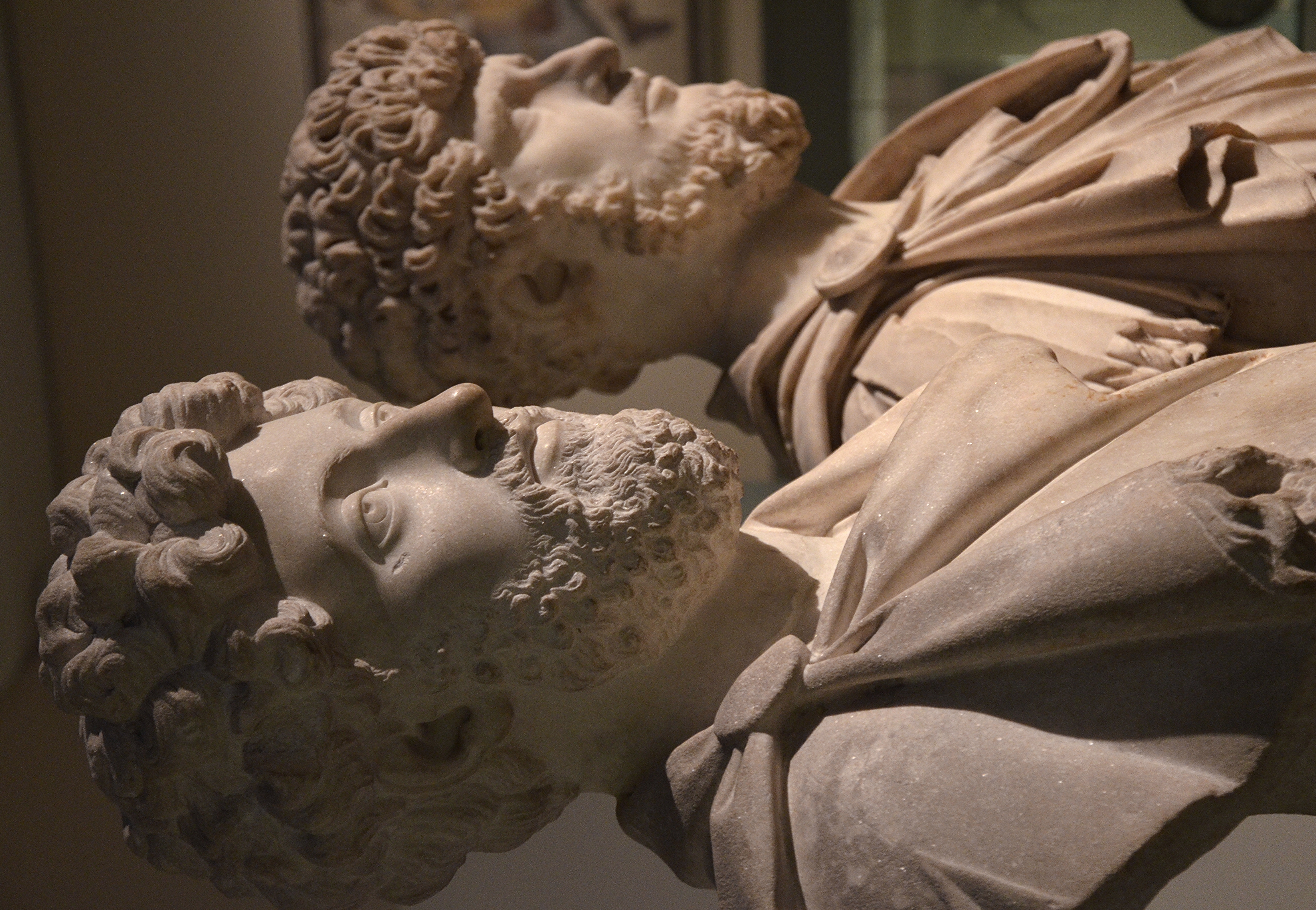
Marcus (left) and Lucius (right) have beards because Hadrian made those popular. Public domain. Photo by Carole Raddato via Wikimedia Commons -
At the time he was adopted Marcus was 17 and not jazzed about suddenly becoming second in line to the empire. He was much more interested in philosophy, specifically the Stoicism that was in vogue in the Roman empire at the time.
-
I'm not a philosophy expert but Stoicism is concerned with virtue being its own reward, and as such earthly pleasures should not be a big concern, and neither should sorrows. Regardless of what life throws at you, you should just get on with things, as it were, stoically.
-
So Marcus was trying to ignore earthly pleasures but suddenly found himself surrounded by earthly pleasures in the palace at Rome as the son of the emperor. He regretted that he found himself unable to resist these temptations; his new brother Lucius had no such qualms.
-
Marcus married Antoninus's daughter, Faustinus, with whom he had 13 children of whom only 6 survived to adulthood. Stoics don't believe in an afterlife and also think it improper to spend much time grieving (be stoic, see?) but he understandably found this very hard to do.
-
Like Augustus, Antoninus didn't wait until he died to appoint a successor in one big bang, but instead slowly handed over more and more power to Marcus as he grew older and less able to manage the empire. He lived a long life and died peacefully, leaving Marcus in charge.
-
Marcus hadn't wanted to be son of the emperor and EXTREMELY didn't want to be emperor, so he insisted that he and Lucius be given equal powers as co-emperors, a novel arrangement that worked out poorly because Lucius sucked and spent all his time hunting, drinking and gambling.
-
Marcus tried to run the empire but Lucius didn't help much. Lucius was sent to prosecute a war overseas but spent years getting there, stopping at every town on the way to sample the pleasures on offer. He did eventually win, but even Lucius credited Marcus for the strategy.
-
When Lucius came back he and his army brought plague back with them, which rampaged through the empire, killing up to a third of the population including, eventually, Lucius himself. Marcus then became sole emperor and continued to rule, but he really hated it.
-
To relieve the pressure of running the empire Marcus arranged his succession as soon as possible, starting to hand over power to his biological son Commodus when the boy was only 15. This was unpopular (succession was usually to capable, adopted sons) and also Commodus in particular sucked.
-
Marcus died at 58, having been in poor health for most of his life. Commodus took over and lasted only 15 increasingly unpopular years before being assassinated, ending the chain of Roman succession and making quite a mess of the empire.
-
Commodus was QUITE the character. Later he would declare himself a god, give himself 12 names, rename the months of the year after those 12 names, and then rename the army, the navy, the senate, Romans themselves and finally the entire city of Rome after himself. The Romans got sick of him at that point and killed him.
-
Marcus' lasting legacy is not his rule but instead Meditations, a series of essays he wrote to himself while thinking about philosophy. He never intended them to be published; they don't even have a title and were referred to as "Marcus writing to himself" for many years.
-
Meditations is by all accounts a master work of philosophy, still recognized today, that influenced many later thinkers. It wasn't what he was trying to do, but still, it's not bad for a kid selected primarily because the old gay emperor thought he looked good in a toga.
- Previously: Hadrian
- Next: Constantine
- Full list
Text and images copyright © 2020-2023 Laurie Voss
except where indicated
except where indicated